Father Campaigns for Online Safety After Son’s Tragic Loss

In July 2022, Brandon Guffey’s life changed forever in Rock Hill, South Carolina. Just weeks after securing the Republican nomination for the state’s House of Representatives, Guffey returned home one night to a house that would soon be defined by tragedy. While his wife, Melissa, and their two other sons were asleep, his 17-year-old son, Gavin, was targeted by an online predator using the Instagram handle BellaJanet28. His wife, Melissa, had gone to bed; his two younger sons, Callahan, 4, and Coen, 16, and both family dogs were sleeping too. The only sounds were the summer cicadas and the frogs calling from the nearby creek – and also the laughter of his 17-year-old-son, Gavin. He wasn’t trying to ‘fit in’ or please anyone.
The perpetrator, posing as a local college student, initiated contact with Gavin. The conversation escalated into a game of truth or dare that prompted Gavin to share intimate photographs. The account holder then used those images to demand money, threatening to distribute the photos to all of Gavin’s contacts. In the early hours of that night, Brandon Guffey heard the final exchange between his son and himself before discovering Gavin in a bathroom, where the teenager had taken his own life using a firearm Guffey had stored at home. The election was three months away, Guffey’s head was buzzing with politics, and he’d spent that evening at a local event. At about 1.30am, Guffey saw Gavin on the landing, where they had that last exchange. A terrifying sound, a crash, like a bowling ball, boomed from the bathroom, where Guffey found his son lying on the floor, moments later.
For the past four years, Guffey has struggled with the memory of that final interaction. He recalls saying, “Goodnight, buddy. I love you,” and believes Gavin replied, “I’ll see you in the morning,” though he admits he can never be entirely certain of the exact words. He describes the aftermath as a permanent state of grief, comparing it to carrying an umbrella under a constant weather system, noting that he views his continued advocacy not as an act of strength, but as a mechanism for survival.
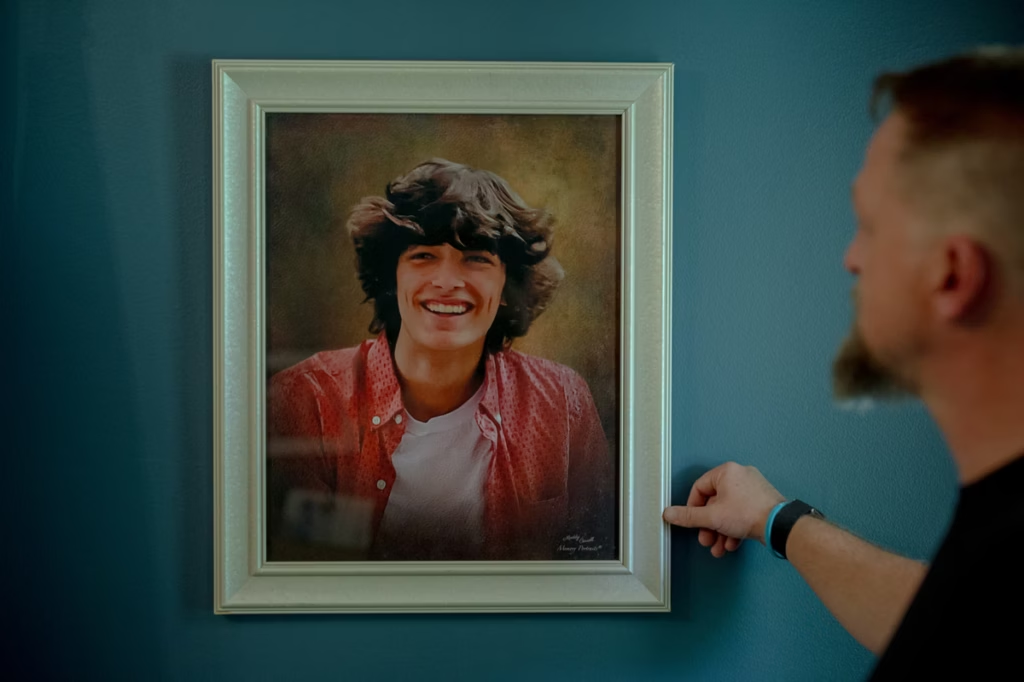
Gavin had been on the verge of starting college with dreams of becoming an art teacher. His father reflects on the period as a time when Gavin was finally comfortable in his own skin. In the wake of the incident, Guffey felt profound guilt, questioning his role as a father and whether his demanding political career had blinded him to the dangers his son faced online. The family home was filled with supporters in the immediate aftermath, providing a brief sense of community, while memories shared by Gavin’s friends helped his parents understand the full, vibrant life their son had led. Headset on, talking with friends, he was gaming in his bedroom. Talking politics on the porch outside, is almost too much to bear – but in the hour that followed, Gavin’s life hurtled towards darkness, the idea that Gavin might have needed his dad when he was unavailable.
The legal fight for justice followed quickly. Guffey and his wife attended court proceedings in Columbia, South Carolina, where they confronted the accused in a case involving charges of child exploitation resulting in death, cyberstalking, and coercion. While the suspect pleaded not guilty, the tragedy propelled Guffey into a legislative career focused on protection. Within a year of Gavin’s death, South Carolina passed “Gavin’s Law,” which classifies sextortion as a felony.
Guffey’s advocacy has evolved into a wider mission to support other families. He reports a shift in his outreach; initially, he mostly received calls from teenagers in distress, but now, more parents are reaching out for guidance. He acknowledges that his personal recovery is ongoing, noting that he often channels his grief into relentless work. Even after successfully passing legislation, he admits he constantly feels there is more to do.
The impact of the tragedy also reshaped how Guffey communicates with his surviving children. After a period of intense struggle, a candid conversation with his 16-year-old son, Coen, served as a turning point in his own grieving process. Recognizing that his children were watching how he navigated his loss, Guffey committed to setting a better example of resilience, despite the persistent pain of his son’s absence. He has documented these experiences and his campaign for safer digital spaces in his bookTomorrow Needs You.