China-North Korea Border Bridge Opens After 12-Year Delay

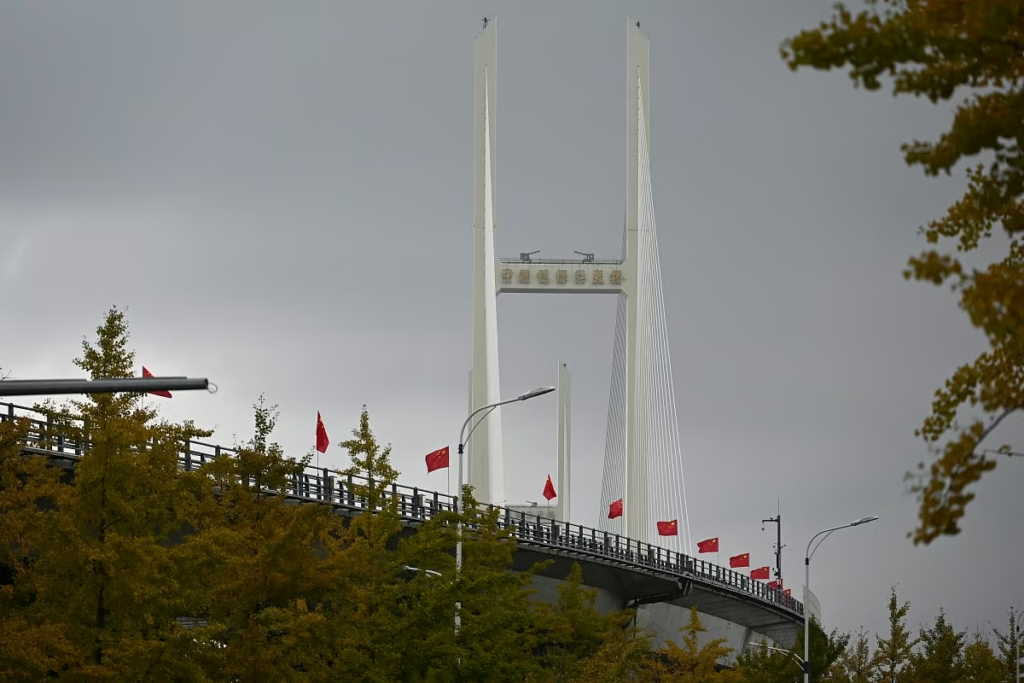
A new four-lane vehicle bridge spanning the Yalu River has finally opened, connecting the Chinese border town of Dandong to North Korea. The 3,026-metre structure, completed in 2014, faced a 12-year delay due to a lack of connecting infrastructure and customs facilities on the North Korean side. The opening arrives shortly after Pyongyang inaugurated its first road bridge with Russia, reflecting a strengthening of ties with its key allies. Taking selfies in front of the 3,026-metre (9,927-feet) New Yalu River vehicle bridge before it opened, hundreds of people gathered on Thursday in the northern Chinese border town of Dandong.
On Thursday, hundreds gathered in Dandong to witness the crossing, with many taking photos of the bridge before operations commenced. By late morning, trucks adorned with the national flags of both nations began traversing the bridge, some North Korean vehicles decorated with flowers to mark the occasion. Local residents, accustomed to a border region filled with Korean shops and restaurants, expressed relief that the long-awaited project is finally operational, noting its potential to revitalize local business. It’s great,” one woman who came to watch told AFP in the town dotted with Chinese as well as Korean shops and restaurants, where residents were relieved the bridge had finally open. It’s certainly going to be good for business,” she said, without wishing to be named, accompanied by her friend and her dog.
Chinese Premier Li Qiang, speaking via video link, hailed the bridge as a symbol of bilateral friendship. He stated that the project signals a new chapter for the two nations, aiming to bolster economic cooperation, trade, and interpersonal exchanges. While China remains North Korea’s largest trading partner and a vital political ally, the relationship has historically experienced fluctuations. According to thanks to the joint efforts of both sides, the successful opening of the bridge will not only strongly boost economic and trade cooperation between the two countries, but will also further facilitate people-to-people exchanges and tighten the bonds of affection between the two peoples,” Li, By video link at the opening ceremony, Xinhua reported.
The new crossing is expected to supersede the ageing, narrow Sino-Korean Friendship Bridge located downstream. Experts note that the older bridge restricted the movement of heavy machinery, construction materials, and energy supplies due to safety limitations. The new four-lane facility is projected to triple or quadruple cargo traffic, providing a much more efficient route for industrial shipments between the two East Asian neighbors.
The bridge opening occurs amid heightened regional tensions. Just a day prior to the inauguration, North Korea conducted a test-fire of two cruise missiles launched from a submarine, as reported by the Korean Central News Agency. This follows a month of tit-for-tat missile testing between North and South Korea, including the deployment of hypersonic weapons.
South Korea’s unification ministry confirmed it is closely monitoring the development. The two Koreas remain technically at war, as the conflict that began in 1950 ended with a 1953 armistice rather than a peace treaty. Furthermore, North Korea’s pandemic-era border closures significantly impacted cross-border movement, with rail services only resuming in March after a six-year hiatus. And train journeys between the East Asian neighbours only restarted in March after a six-year halt, north Korea also sealed its borders during the Covid-19 pandemic. Putin and Kim sign mutual defence pact. Why did CXMT’s chip claim sparks a selloff on KOSPI.
Although the bridge is now open for cargo, tourism remains limited. Pyongyang has not yet resumed issuing entry visas for Chinese tourists, who previously constituted the majority of the country’s foreign visitors. The increased connectivity follows a broader trend of North Korea deepening its diplomatic and military cooperation with Russia since the 2022 invasion of Ukraine, with Pyongyang providing troops and gaining access to economic and military technology in return. North Korea poised to admit first tourists since 2020.