Usman Khawaja Claims Entire Team Knew of Ball-Tampering

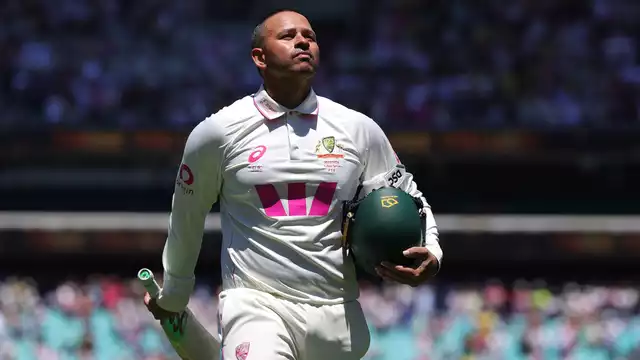
More than eight years after the infamous ball-tampering scandal in Cape Town, former Australian batter Usman Khawaja has claimed that the entire team was aware of the use of sandpaper. In revelations set to feature in his upcoming autobiography, Sabr, Khawaja asserts that the illicit practice was not confined to the Cape Town Test alone, but was also employed during the preceding match in Port Elizabeth (Gqeberha). “Maybe I thought Davey would have exposed it, or someone else would have talked about it more. “Even in the change rooms when I was talking to them after the game.
These assertions directly challenge the 2021 joint statement issued by Australia’s bowling quartet—Mitchell Starc, Pat Cummins, Josh Hazlewood, and Nathan Lyon—who had previously denied having any knowledge of the tampering taking place. And right from the very start, I’ve been on the train of collectively taking it, but the longer it’s gone on for.
Reflecting on the event, Khawaja told the Sydney Morning Herald, “It was all of us.
Not the batters, not the bowlers, not the staff. All of us. During the 2018 series against South Africa, footage showed Cameron Bancroft concealing sandpaper in his trousers. Following the incident, captain Steve Smith acknowledged that a “leadership group” had plotted the action. Consequently, Smith and vice-captain David Warner received 12-month bans, while Bancroft was suspended for nine months. Smith was further barred from leadership roles for a year, while Warner’s career-long captaincy ban was only rescinded in 2024. While Warner was given a lifetime captaincy ban which was later removed in 2024, following which he was named Sydney Thunder’s captain, smith was also banned from holding any leadership position in Australian cricket for a further period of 12 months. And then the penalties were given, and I couldn’t believe it.”, it just never rang.
Khawaja revealed that he had urged his teammates within the dressing room to accept collective responsibility for the scandal rather than allowing the three sanctioned players to bear the consequences alone. “I said, ‘Take this as a team’. We did this as a team. We knew what was going on, and we have to take it as a team,” he explained, expressing his disappointment that the fallout resulted in those specific individuals being “crucified.” None of those three want to be the first to say anything. According to “If you read my story, if you read what I’m saying, I have numerous times, It’s us, the team. “At the end of the day, I still think it’s the right thing to do for particularly those three guys.
The veteran batter, who concluded his international career following the recent Ashes series, noted that he remains surprised he was never interviewed by Cricket Australia during their post-incident investigation. He believes the board may have avoided speaking to him because they knew he would advocate for collective accountability. “I was sitting next to Cam Bancroft that whole Test match, and I didn’t get interviewed. I thoroughly feel that I didn’t get interviewed because of that, because they knew that I wanted to take it as a team, because they knew I was ready to tell the truth,” he stated.
Khawaja maintained that his decision to speak out now is motivated by a sense of fairness toward Smith, Warner, and Bancroft, arguing that they have lived with the stigma for too long. He noted that he informed Pat Cummins, the current Test captain, about the contents of his book prior to Australia’s recent tour of South Africa. “In an ideal world, I don’t want to do this,” Khawaja was quoted as saying by the aforementioned source. “I don’t want to be the one who comes out and talks about the truth. According to khawaja, He spoke to Cummins, the current Australian Test captain, ahead of the recent tour of South Africa where Australia lost the Test rubber 2-1, about his book and that he was going to open up about the bal.
“I’ve always felt like there’s more to life than just cricket, and these guys, in some respect, deserve that justice,” Khawaja said. “It just doesn’t feel like anyone’s going to give it to them.” He acknowledged that his admissions might cause some short-term disruption but expressed hope that the truth would finally allow the team to move past the incident. And that it was an opportunity to put the issue to bed, but he was firm that he revealed the truth.
While acknowledging the gravity of the situation, Khawaja insisted that his account is consistent with the reality of the team’s dynamics at the time. He expressed hope that by clarifying the collective nature of the oversight, it might offer some relief to those who bore the brunt of the sanctions.