Spain Train Crash: At Least 69 Dead After Collision Near Urda

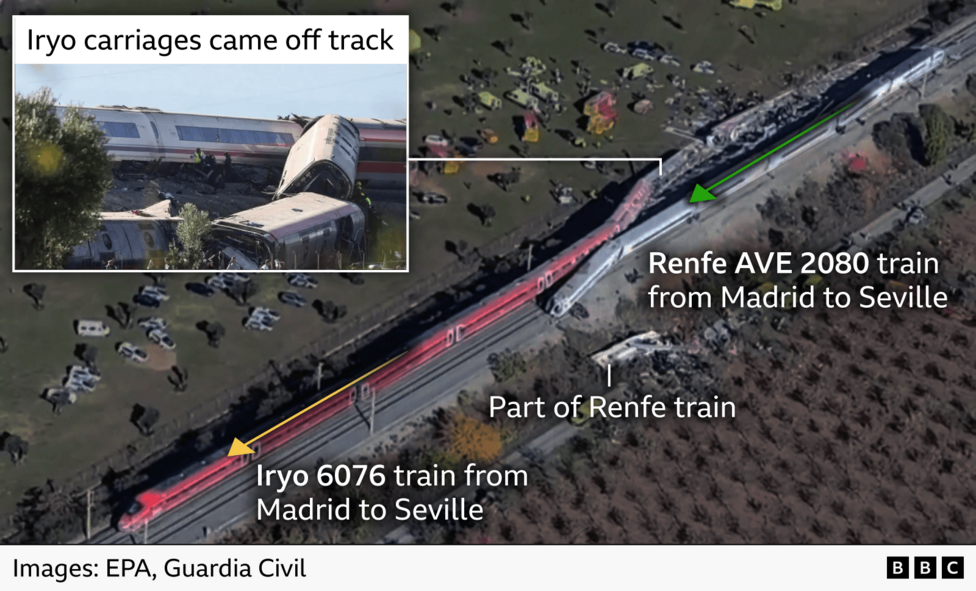
A catastrophic collision between two passenger trains occurred on Wednesday morning in the province of Toledo, Spain, resulting in at least 69 fatalities. The accident took place on the high-speed rail line connecting Madrid to Seville, specifically between the municipalities of Mora and Orgaz, approximately 140km south of the Spanish capital. And about 140km (100 miles) south of Madrid, according to an account given by the Spanish government, the crash happened at 08:53 (07:53 GMT) between municipalities Mora and Orgaz. A passenger on board one of the trains told local media there was a heavy impact about 40 minutes into the journey.
Crash Timeline and Location
- Time of incident: 08:53 (07:53 GMT)
- Location: Near the town of Urda, south of Madrid
- Primary cause: Computer failure leading to system malfunctions
The tragedy unfolded when a Renfe train slammed into the rear of a stationary Iryo train. Iryo officials confirmed their train was struck from behind due to causes currently under investigation. The force of the impact caused several carriages to tumble down an embankment, halting all traffic along the critical route and forcing the suspension of services between Madrid, Ciudad Real, and Andalusia. Watch: Aerial footage shows train crash scene. Here is what we know about the crash so far. Where and when did the crash happen.
Transport Minister Óscar Puente explained that a computer failure at 08:30 triggered an automatic halt for six moving trains, including the two involved in the fatal crash.
Under normal operating protocols, a control center should intervene when systems fail.
However, Puente stated that the center authorized the trains to resume travel under what he described as inexplicable circumstances, specifically allowing them to proceed without standard speed restrictions. The control centre takes over,” he said, adding it was the control centre that decided to allow the trains to move again, without any speed restrictions, in the event of a system failure.
Leaked audio recordings from rail infrastructure firm Adif suggest that a high-speed train received clearance to continue at 08:36, despite another train remaining stalled just 25km ahead. In the recordings, a controller instructs a Renfe driver to disconnect and reconnect the LZB speed-monitoring mechanism and proceed at normal operational speed. When the driver questioned the instruction, the controller insisted on normal speed.
Under established safety protocols, the driver should have proceeded at a maximum speed of 40km/h while maintaining visual contact.
This standard is required when using the Lateral Signaling Block, a backup system activated during primary signal failures.
Further recordings indicate that the Iryo train driver had notified the control center of their stationary status in front of the entry signal at Urda, eventually reporting that the security system would not allow them to restart, yet they were still instructed to resume the journey. The control centre operator tells the driver to “resume the journey” normally, after some exchanges.