Decades of Israeli Nuclear Ambiguity Face New Geopolitical Pressure

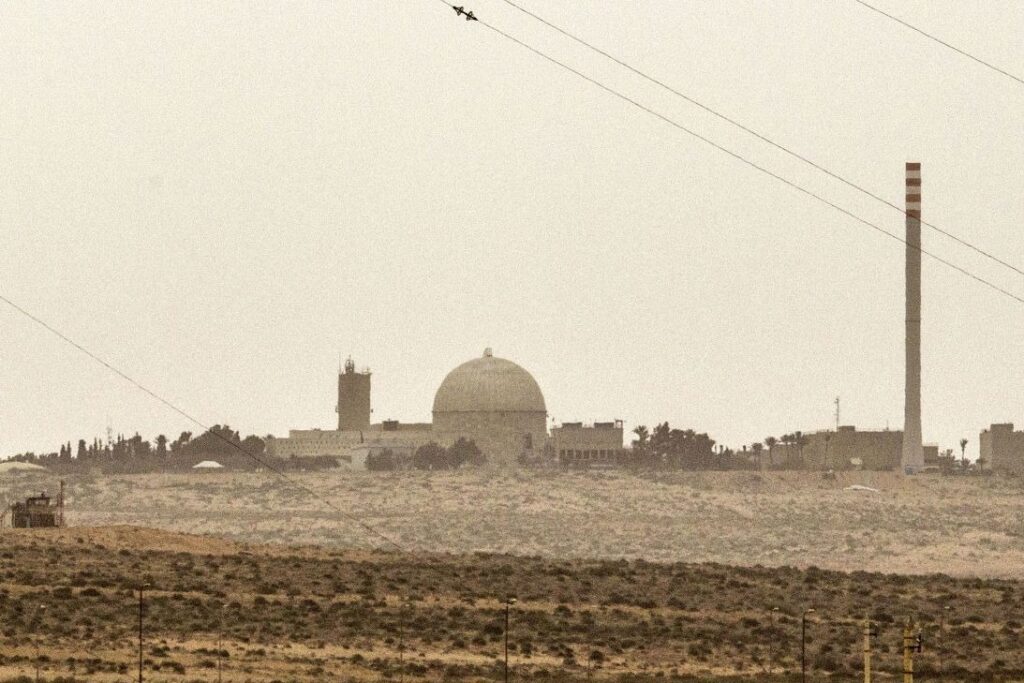
In early 1960, a group of American diplomats flying over the Negev desert observed a mysterious construction site located 20 miles west of the Dead Sea. When the U.S. ambassador to Israel, Ogden Reid, and his team inquired about the facility, their Israeli escort, Addy Cohen from the Finance Ministry, dismissively described it as a textile factory. This encounter marked the beginning of what has since become the world’s worst-kept secret: the development of the Middle East’s only nuclear arsenal at the Dimona site. The US and Israel have played coy, neither acknowledging the development of Israel’s nuclear arsenal, for the 60 years since. Israeli Prime Minister Benjamin Netanyahu referenced a “textile factory” meeting with the country’s Atomic Energy Commission head in a July 14 speech. And a group of Democratic lawmakers and advocacy groups has been arguing in recent years that it’s time for the US to stop pretending about Israel’s bombs.
A secret U.S. diplomatic telegram revealed that while Cohen initially treated the inquiry with levity, he internally acknowledged the potential for the reactor to be utilized for weapons purposes. By 1965, the suspicion intensified after U.S. officials discovered that a Pennsylvania uranium facility had lost hundreds of pounds of weapons-grade material, leading some intelligence experts to suggest the supply was diverted to the Israeli program. This long-standing, coy relationship between Washington and Tel Aviv has maintained a status quo where neither nation officially acknowledges the nuclear program, a policy often euphemistically referred to as the textile factory. According to “Cohen at first treated the matter with levity, (but the) impression came through that he believed (the) reactor could be used eventually for weapons purposes,”, A secret US diplomatic telegram, part of a trove of declassified documents collected by the National Security Archive that also include details of the helicopter ride. Meanwhile, a nuclear cooperation agreement between the US and Saudi Arabia is pending before Congress. US inspectors never found the secret underground facility beneath Dimona that was used to create bomb-grade plutonium — Israeli officials would wall off its elevator before inspectors arrived, according to a 2024 Hebrew.
The era of strategic ambiguity is now facing fresh challenges as regional dynamics shift. Following ongoing conflict, Iran continues to hold nearly 1,000 pounds of highly enriched uranium. Nonproliferation expert James Acton of the Carnegie Endowment for International Peace recently estimated a 50-50 chance that Iran could obtain a nuclear weapon in the near future. This development has sparked debate among U.S. policymakers regarding the efficacy of maintaining the existing silence on Israel’s capabilities.
President Donald Trump recently indicated that the U.S. might terminate nearly $4 billion in military aid to Israel, citing that the country no longer requires such assistance. The once ironclad support for Israel’s military ambitions may be starting to corrode in the US. According to on Tuesday, President Donald Trump, The US may cut off nearly $4 billion in military aid to Israel at the end of the year because “they no longer need it.
Concurrently, Representative Joaquin Castro has criticized the policy of ambiguity, arguing that it is outdated and risky for the United States to commit to potential joint military engagements without a clear understanding of Israel’s nuclear red lines or contingency plans. During a congressional hearing, Secretary of State Marco Rubio acknowledged that while the global consensus holds that Israel possesses nuclear weapons, the lack of public admission remains a fixed, long-term feature of American foreign policy. But never formally confirming, Israel’s nukes, the policy observed by the US and Israel is now one of opacity or ambiguity — hinting at. The policy has helped the US maintain a public stance against additional countries developing nuclear weapons and helped Israel avoid questions about how (or whether) it got the bomb. Castro, a member of the House’s Foreign Affairs and Intelligence Committees, suggested that it’s risky for the US to fight a war alongside Israel and not know “their red line” for nuclear use and “not describe what conti. Transparency could also further undermine US credibility as it continues to argue against countries joining the nuclear club. “If Israel were to come out and announce that it were a nuclear power, that may increase pressures on other countries in the region to follow suit,” argued Matthew Kroenig, a nuclear strategist and political science prof. There also “was no question even among the scientists about Israel’s need to develop them,” the memo said. It might also trigger economic sanctions or arms sale embargoes designed to punish countries seeking the bomb. The White House did not respond to a request for comment. According to “I think most of the world assesses that they do, but we’ve never — they’ve never, acknowledged that publicly,”, Rubio. “And as a feature of our foreign policy, for a variety of reasons, we don’t discuss it in that way, either.”.
Historically, this silence was cemented during the Cold War to prevent a nuclear arms race in the Middle East. Documents from the National Security Archive detail how Henry Kissinger, after meeting with then-Deputy Defense Minister Shimon Peres, believed Israel was firmly committed to nuclear advancement. Despite fears that an acknowledged Israeli arsenal would provoke Arab states, the U.S. chose to avoid imposing strict conditions, fearing the diplomatic fallout of an arms embargo. Consequently, Israel avoided signing the Treaty on the Non-Proliferation of Nuclear Weapons. It would force a reckoning over the roots of Israel’s nuclear technology and the years of cat and mouse games meant to prevent definitive proof of the weapons program from emerging, if the facade of deniability is disposed of. He would assume the role of national security advisor in the Nixon administration less than four years later in 1969. Rubio, who after Henry Kissinger is only the second American to serve simultaneously as top diplomat and national security adviser, provided perhaps the frankest public assessment that any US diplomat ever has on the matter.
Experts warn that if the façade of deniability were to collapse, it could trigger a broader regional pressure for other nations to pursue similar technology, potentially destabilizing international nonproliferation efforts. While the U.S. State Department maintains its longstanding policy of refusing to comment on specific nuclear platforms or foreign capabilities, the geopolitical realities of 2026 suggest that the decades-old diplomatic shield may no longer hold the same strategic value it once possessed during the height of the Cold War.