


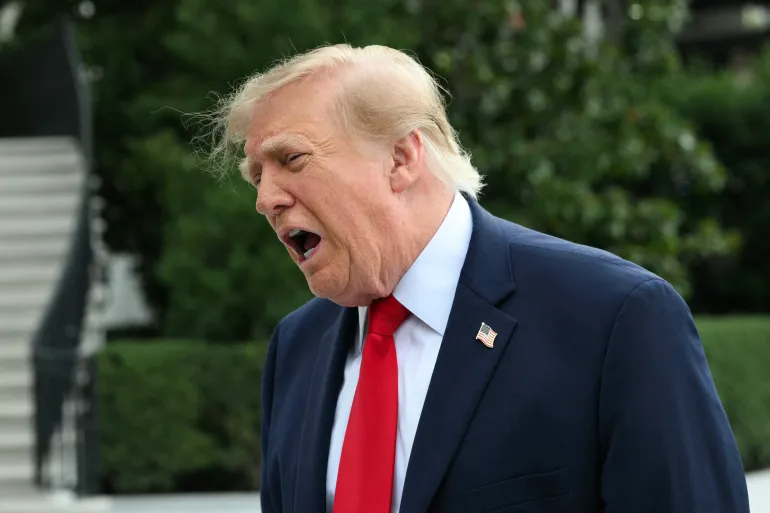
It’s Donald Trump as he wants America to see him.
This is the president as a relentless, square-jawed strongman, in unambiguous monochrome, in a video featuring an echoing voice track in which he vows “a final battle” against communists, the deep state and “fake news” media.
But the most provocative aspect of the 30-second spot that aired during NFL broadcasts Sunday is the tagline: “Paid for by the U.S. Government.”
This raises key questions.
Is the video, similar to one Trump posted on social media during his 2024 campaign, a legitimate use of public money, in what the White House says is a public service announcement? Or does it represent another blow to good governance by a president who recognizes few limits on his power? In this instance, using taxpayer funds — inevitably including those of citizens who oppose his agenda — for a hyper-political message pre-midterm election message?
Democrats have raised alarm at recent similar videos that also used taxpayer cash. Consumer advocacy group Public Citizen filed a complaint with government ethics watchdogs. And one Republican senator, John Kennedy of Louisiana, told CBS News’ “Face the Nation” Sunday that no public official should spend public money on “private ads for themselves.”
A supporter of the White House position might argue there is some subjectivity in what constitutes a political ad as distinct from a video that purportedly seeks to highlight higher national interests. But this controversy is playing out in an administration that has repeatedly challenged norms and taboos regarding politics and nonpartisan governance. And there will be deep skepticism over whether a president who has purged inspectors general, ethics officials and civil servants from his own government cares about such concerns.
The furor is a classic example of provocative behavior Trump uses to draw establishment forces into showdowns that bolster his image as an insurgent, a move that was instrumental to his two presidential election triumphs. At times, this seems like trolling for trolling’s sake. But it feeds a narrative that he’s under perpetual attack from a sinister deep state and that only strongman leadership by Trump can save the nation. The idea that the spot is deliberately provocative is bolstered by the fact that Trump, with a war chest worth hundreds of millions of dollars, doesn’t need to use taxpayer cash.
The timing also cannot be ignored: five weeks ahead of congressional elections in which Republicans fear defeat in the House and the Senate. The video’s hero narrative is exactly the kind of messaging that might drive out quintessential Trump voters whom the GOP needs to turn out in droves, even when Trump isn’t formally heading midterm tickets.
This imagery of Trump as an omnipotent figure also contrasts sharply with his political fortunes as polls show Americans rejecting his policies on the economy, the war in Iran and his refusal to regulate artificial intelligence as lame duck-status beckons.
White House dismisses controversy and says Americans “should” be proud
The White House said in a statement to CNN — which was similar to its response to previous videos — that these “public service announcements are about reminding Americans to love their country and understand what makes it worth defending, at home, at our borders, and abroad.” It added that “the ad is educational and unapologetically patriotic. We should be proud of our country.”
The White House also argued that since Trump is not on the ballot in the midterms, the videos are not political. Yet the president implored supporters at his “midterm convention” in Texas to “pretend that I’m on the ballot.” White House Communications Director Steven Cheung wrote on X: “don’t let the Fake News get away with their lies about our epic Public Service Announcements that have been running on tv.”
The administration listed specific examples of previous public service advertisements promoted by presidents, including George W. Bush, Barack Obama, Joe Biden, Woodrow Wilson and Franklin Roosevelt.
The semantic debate on Trump’s ad will focus however on whether the supposed crisis he invokes — of a land under siege from Marxists, globalists and “fake news” — bears any resemblance to threats from Covid-19 in the case of a Biden video or Nazis and Japanese imperialism in FDR’s material.
Biden’s pandemic video was not overtly political — in trying to get shots in arms to end the crisis — but the entire issue of the government’s response was drawn into the treacherous politics of the global health emergency.
The comparison to FDR’s Office of War Information seems more obviously tenuous. The body was formed in June 1942 to promote the status and progress of the World War II effort and the US government’s policies. By that time, the US had been attacked at Pearl Harbor. The US Navy had been in action in the Pacific War and American bombers would soon be over Nazi Germany, but the comparison to the World War II crisis is questionable.
New controversy over Trump’s video also recalls a storm over tens of thousands of dollars in taxpayer funds spent on a campaign showcasing former Homeland Security Secretary Kristi Noem shortly before she left office, according to invoices seen by CNN.
Opponents warn of ‘North Korea’ style ‘propaganda’
The idea that America is in peril is at the core of the Trump’s midterm election campaign and Republican warnings that socialists and communists are plotting a takeover. While democratic socialists are increasingly vocal in the Democratic coalition, it is ahistorical to directly compare them to Soviet totalitarians.
In any case, Trump just spent three days hosting the world’s most powerful communist, Chinese leader Xi Jinping, at a state visit, even if modern-day Chinese communism is most defined by the authoritarian nature of the creed rather than collectivist economics.
Trump’s stark video, in which he walks unsmilingly toward the camera, will also deepen disquiet among critics of his authoritarian imagery. As will the White House statement telling citizens what they “should” be proud about. The video also comes at a moment when the administration is challenging constitutional rights and freedoms enjoyed by the press — and every American — under the First Amendment. Key legal rulings are pending over the White House’s canceling of permanent entry passes for three media organizations, following a judge’s temporary suspension of the ban, and the administration’s blocking of CNN from a weekend pool rotation.
Top Democratic appropriators in Congress wrote to White House Chief of Staff Susie Wiles last week demanding that a previous Trump video be withdrawn and warning that the use of taxpayer funds was unlawful.
“This is the sort of government propaganda one might expect in North Korea, not the United States of America, and it is an egregious and utterly illegal misuse of Americans’ hard-earned tax dollars,” read the letter, signed by lawmakers including Washington Sen. Patty Murray, Rhode Island Sen. Jack Reed, Connecticut Rep. Rosa DeLauro and Maryland Rep. Steny Hoyer. They wrote the video was a “blatant violation” of Section 718 of Division E of the Consolidated Appropriations Act of 2026, which forbids federal funds from supporting propaganda, and was also an apparent violation of other federal ethics laws, including the Hatch Act.
Public Citizen lodged a complaint with the Government Accountability Office and the US Office of the Special Counsel contending that two previous Trump videos are an “affront to taxpayers and our democracy.”
But as always with the current administration, the question will be whether such questions are taken seriously within government. If Democrats win congressional majorities in the midterms, Trump’s recent ads may be drawn into an aggressive regime of oversight and investigations. But one lesson of the Trump era is that constraints on presidential power may not mean much when the executive makes a conscious decision to ignore historic norms around the office. And it would not be surprising if future presidents, including Democrats, exploit openings the 47th president forged.
Have any thoughts?
Share your reaction or leave a quick response — we’d love to hear what you think!
-
 0
0
-
 0
0
-
 0
0
-
 0
0
-
 0
0
-
 0
0