France Deploys 70,000 Police Amid Nationwide Protest Warnings

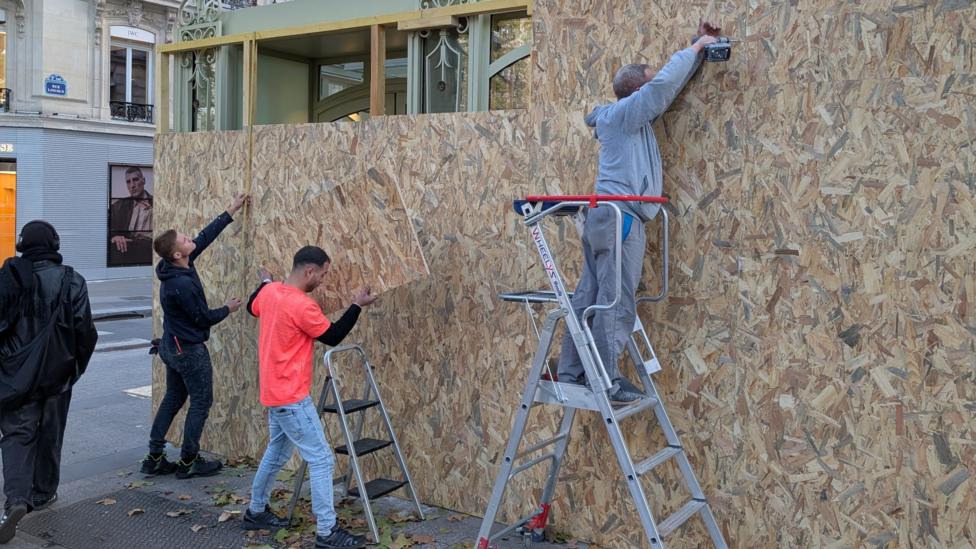
France is on high alert ahead of a new day of nationwide protests this Saturday, exactly one week after the country experienced some of its most severe civil unrest in decades. Authorities have imposed sweeping restrictions on demonstrations across major cities, yet hundreds of thousands of protesters are still expected to gather. In response, the interior ministry has announced the deployment of 70,000 police officers to ramp up security, a measure taken after the government faced harsh criticism from opposition parties for failing to foresee the scale of the riots that erupted on 17 October. Several key cities including Lyon, Nice and Montpellier have gone further by announcing blanket bans on gatherings. There is an inconsistent picture as to what level of protest will be permitted by authorities, after a week in which some cities have lived under partial curfews. Protesters associated with a revived gilet jaunes (yellow-vest) movement could be out in force across France on Saturday, in a sign of how a student-led protest movement expanded to become a wider anti-government outpouring. According to the group, “we refuse to add our voices to the chorus of outrage” over the violence on 17 October and accused police of attacking protesters.
Security and Judicial Response
- Interior Minister Laurent Nuñez declared: “We will not let anything go unchallenged.”
- Nuñez emphasized that the state would remain “uncompromising with the vandals, with the looters, and all those who commit acts of violence.”
- He noted that, beyond the planned protests, authorities have monitored numerous calls for violence on social media originating from the “far left and radical extreme left.”
- Justice Minister Gérald Darmanin confirmed that 232 people have been imprisoned for their roles in the previous week’s unrest, while more than 1,100 others have appeared in court during fast-track hearings.
- Darmanin has directed prosecutors to seek punitive measures, including bans on participating in future demonstrations, removal of voting rights, and restrictions on social media access for those convicted of looting or attacking officers.
Disillusionment remains high among the French public, many of whom have endured mounting cost-of-living pressures and are now facing dire warnings that any future government will likely impose deep spending cuts. The initial unrest was sparked by demands from high school students calling for improved school conditions and the resolution of severe staff shortages, though the situation spiraled into violence in several locations. Sensing fertile ground among the French public after a period in which his centrist party has struggled to form func, leading figures from both parties have levelled the blame for the disorder at Macron and his ministers.
Protest Dynamics and Political Tensions
President Emmanuel Macron held discussions with high school student representatives on Friday.
While the students acknowledged the president made clear commitments to improve high school education starting Monday, they maintained that students should “continue to mobilise.
Despite these negotiations, official announcements have failed to deter organizers.
A website associated with the protest groups has listed over 500 demonstrations and 200 additional actions for Saturday, while explicitly demanding President Macron’s resignation. The movement has also criticized the official narrative, accusing the police of attacking protesters during the previous week’s unrest. Macron decreed earlier this week that only demonstrations organised by a recognised trade unions would be permitted to take place on Saturday. Which has attracted support from both the left and right, led huge disruptive demonstrations during Macron’s first term in office, the protest movement. He added, around 260 of those cases involves “charges of organised gang activity”. Despite a court finding her guilty of embezzling EU funds earlier this year, opinion polls suggest Le Pen could have her strongest chance yet of becoming president as she runs for a fourth time. Macron will leave office next spring and polls suggest a candidate from his centrist movement could fail to make it through to a run-off vote in May. As he did the previous week, before condemning the rioting that followed, he has called on his supporters to join protests on Saturday.
The logistical landscape for Saturday remains fragmented. In Paris, a march organized by student trade unions and supported by labor groups has been restricted to a route that avoids the city center, though authorities are preparing for potential unrest across the most recognizable parts of the capital regardless. Many institutions are taking preventive measures: the Louvre, Orsay, and Picasso museums will remain closed, and a scheduled PSG football match has been moved to Monday.
Political Flashpoints and Regional Impact
France is still reeling from the destruction caused last week, which included the burning of the ornate 19th-Century town hall in Limoges.
Prime Minister Sébastien Lecornu confirmed that the national government would fund the reconstruction of the building to its original state.
Meanwhile, the National Rally party’s two-day conference in Orléans is viewed as a potential flashpoint. Around 120km (75 miles) to the south of Paris, could prove to be a flashpoint on Saturday, a two-day National Rally conference in Orléans.
The mayor of Orléans has warned that the expected crowd numbers are “unprecedented” and noted that public transport will be suspended to manage the threat of clashes.
As the unrest continues, opposition leaders continue to target the centrist government’s struggle to pass legislation, while Jean-Luc Mélenchon, leader of LFI, has accused Macron of “destroying the republican state” through heavy-handed policing tactics.