NZ Astrophotographer Fights AI Accusations Over Viral Night-Sky Image

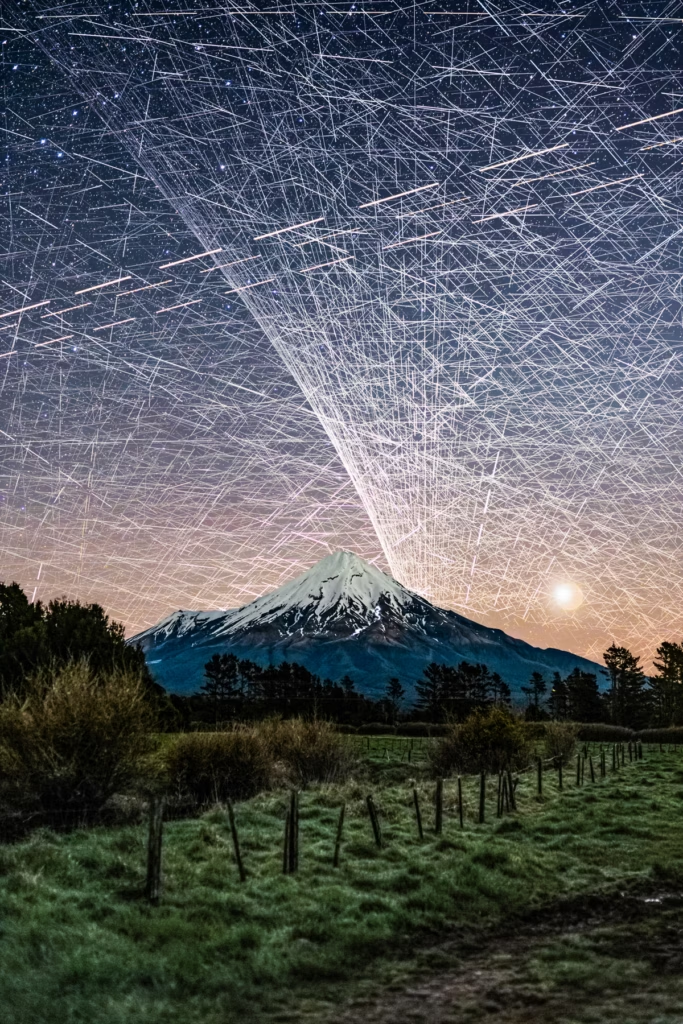
An extraordinary photograph capturing thousands of satellites traversing the night sky over New Zealand has gone viral online, but its surreal detail has forced the astrophotographer behind it to defend his work against accusations of being generated by artificial intelligence.
Brendan Larsen, 51, captured the foundation of the spectacular image over Mount Taranaki on the North Island in September. He set his camera to continuously capture eight-second exposures with two-second intervals, recording 578 individual photographs over a two-hour window, which he noted was the easier part of the process. According to larsen, 51,, He set his camera up to take an unlimited number of eight-second-long shots, with a two-second gap in between each photo. “I left her running for two hours and captured 578 photos … That was the easy par.
The extensive post-production required roughly 40 hours of meticulous work using Adobe Photoshop. Larsen layered the images—each containing around 25 visible satellites—over one another while systematically removing stars to bring the satellite pathways into sharp focus. To reveal the satellites, much of the time was spent painstakingly erasing stars.
As he worked through the editing process, Larsen watched the complex network take shape. “I could start to see the pattern emerging and realised: ‘Wow, this looks really awesome.’ I knew if I carried on it would look even better and more impressive in terms of satellite numbers,” he recalled.
The completed image reveals a dramatic night sky filled with approximately 1,400 satellites and 14,000 light trails, creating a dense crisscrossing grid above the mountain landscape.
After Larsen shared the final piece on social media in mid-October, it gained tens of millions of views, generated thousands of comments, and brought him 15,000 new followers. However, it also prompted widespread skepticism from online viewers who assumed it was synthetic artwork.
Addressing the doubts, Larsen admitted that modern AI image generators make it increasingly difficult to distinguish real photography from synthetic media, particularly for viewers unfamiliar with astrophotography or the local terrain. While acknowledging the rationale behind the skepticism, he conceded that the persistent doubts remain frustrating, especially as others have used AI tools to replicate his work with visible flaws.
To counter the backlash and provide proof of authenticity, Larsen recorded his editing workflow on video, hoping to offer viewers a genuine perspective on his artistic process and his connection to the natural landscape.
His interest in sky photography stems from childhood memories of being awestruck by rural New Zealand’s star-filled skies. Over six years of astrophotography, however, he has observed a noticeable rise in satellite congestion and light pollution, leading to mixed emotions about the phenomenon.
“It’s interesting and fascinating seeing satellites, but it’s also disturbing,” Larsen explained. He noted that out of roughly 10,000 comments on his Facebook page, nearly 90 percent reflect a shared sentiment, with users calling the image visually stunning yet terrifying regarding the state of Earth’s orbit.
The image highlights a rapidly growing environmental and technological issue. Currently, about 16,000 operational satellites orbit Earth alongside tens of thousands of inactive spacecraft, discarded rocket stages, and fragmented payload debris. Scientific studies indicate that metallic particles from space hardware reentering the atmosphere could impact atmospheric chemistry and the ozone layer, while UN warnings highlight risks to ground safety, scientific astronomy, and dark skies. About 16,000 working satellites are circling the planet, alongside tens of thousands of defunct spacecrafts, rocket parts and debris from payloads breaking up.
Although satellites are not yet this overwhelming to the naked eye, Larsen hopes his viral photo will spur public discussion on environmental protection for the atmosphere. “We can raise awareness, and through that get a groundswell of support for protecting the night sky,” he said.