


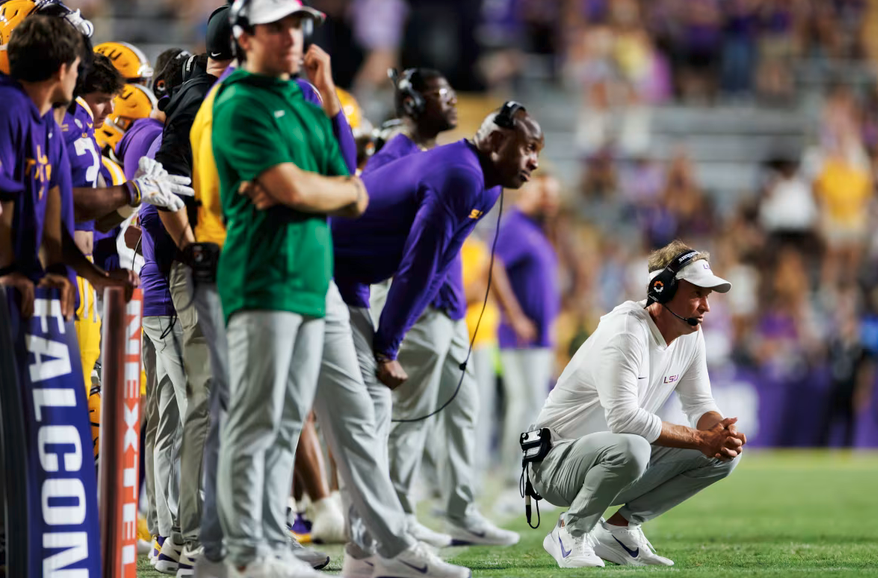
Oxford, Mississippi —
The Library Sports Bar is everything a college bar should be. Old, battered stools stand alongside a weathered wood bar. Stickers celebrating bygone 21st birthdays cover the walls outside the bathrooms. The barroom gives way to the Boom Boom room (for bands), which leads to the patio, all designed for mobs of undergrads who want cheap drinks and a place to hang.
In 1997, John Desler, a former Ole Miss defensive back, and his wife, Leelee, bought the guts of the place from James Purvis, proprietor of Purvis Pool Hall and the town’s most renowned bookie. The Deslers slowly expanded The Library, eventually stretching its reach down nearly the entire block.
It was Leelee who decided to hang the flags out front, one for each of the Rebels’ football opponents. Every time Ole Miss won, she decided, she’d replace the opposing colors with a red flag that read, “Rebels Take the Win.”
Last season, all but one of the opponents’ banners disappeared. Eventually, 13 “Rebels Take the Win” flags fluttered down Van Buren Avenue, a visual affirmation of the best season here since Archie Manning was the biggest man on campus.
On this, the last Sunday afternoon before football returns to Oxford, the 2026 season flags stand at the ready as Elizabeth Heiskell ducks into The Library.
“I cannot wait to take that LSU flag down,” she says to everyone and no one in particular. “I mean, we’re all over it, but we want that win.”
Heiskell was born and raised in the Delta, the northwest section of the state often called the most Southern place on Earth. She attended Mississippi State, but wound up living in Oxford when her husband, Luke, had the harebrained idea to start a vegetable farm outside of town. Heiskell went from delivering vegetables to restaurants in a beat-up, old prison van with no air conditioning to the preeminent caterer in town, author of three cookbooks and a regular contributor to the “Today” show.
Her time in Oxford also shifted her loyalties. She is now as fierce an Ole Miss fan as you’ll find. She has a regular spot reserved in the Grove and closes texts with “Hotty Toddy.” Both a Southern charmer and a Southern spitfire, she peppers her yarns with smirks and eye rolls and is unabashed about both possessing and sharing her strong opinions.
A year ago, her Rebel devotion and outspokenness got her into a little hot water. As football coach Lane Kiffin dithered about abandoning Ole Miss for LSU, Heiskell declared she would run “nekkid” around the Oxford square if Kiffin bolted. Heiskell’s vow went viral and she wound up discussing her proclamation live on “The Paul Finebaum Show” during the SEC Championship.
Of course, Kiffin left, a bitter and acrimonious separation that played out over 14 agonizing days, just as the Rebels prepped for their first College Football Playoff game in history.
Heiskell kept her clothes on. She did not and has not, however, kept her mouth shut. Sitting later at a quiet table in the back of Saint Leo’s, an Italian spot on the Oxford Square, she is asked to explain the vitriol directed at Kiffin. She gives one of her smirks.
“Well, he’s an immoral, son of a b*tch whore,” she says and then pauses. “Well, maybe leave the whore out.”
The Grove is quiet on a Monday afternoon, the tree-covered acreage at the center of the Ole Miss campus looking like little more than a nice place to catch some shade from the omnipresent heat.
“It will be a war zone.” That’s what Russ Eddins, sports editor of the student newspaper, The Daily Mississippian, predicts the tailgating epicenter will feel like this Saturday, when Kiffin returns to town. So worried is the Oxford-born senior he has suggested that his family, who still live on the outskirts of the city, not come.
The setup is, to Eddins’ point, ripe for catastrophe. ESPN has slated kickoff for 6:30 p.m. local time and will bring their flagship college football program “College GameDay” to campus. Whatever lather the pre-game show doesn’t create, the hours’ worth of day drinking undoubtedly will.
Rick Cleveland first started covering Ole Miss football in 1981 as the team’s beat writer for the Clarion Ledger in Jackson. Now 73 and working for Mississippi Today, he is frankly surprised the Kiffin-Ole Miss partnership lasted as long as it did. He figured the coach, who has made a career out of chronically looking for his next move, would have left for another job long before he eventually did. Cleveland, in fact, is quick to remind folks that before he left for Baton Rouge, Kiffin also petitioned for the open jobs at Miami, Auburn and Florida.
Cleveland also presumed rightly that Kiffin’s professional wandering eye meant the pairing was destined for a bad ending. But even he is surprised at the level of venom. Despite decades of watching Ole Miss game, he can’t come up with a comparison to what the atmosphere might be like.
“I’ve seen much lesser situations where liquor bottles and beer cans have been thrown on the field,” he said. “This could get ugly.”
In her bright office a few blocks away from the Grove, Oxford Mayor Robyn Tannehill says she’s hoping for the best and preparing for the worst. The “Mama Mayor,” as she likes to call herself, is counting on her flock to mind their P’s and Q’s.
“I think this will be,” she says, pausing to choose her words carefully, “a very spirited, heated game. I think the Rebels are prepared and the city of Oxford is prepared and I think we’ll send Lane Kiffin home with a frown on his face and an L on his schedule.”
That said, Tannehill does mention that the New Orleans and Mobile, Alabama, mounted police have volunteered their assistance to monitor crowd control.
Hell hath no fury like a football fan scorned, and Kiffin’s messy exodus from the school he raised into a playoff contender is about as bad a divorce as you’ll find in recent memory. Rick Pitino returned to Kentucky as the head coach for rival Louisville but that was after a four-year detour in the NBA. Nick Saban did a similar U-turn, going back to LSU as the Alabama head coach after a crash and burn in the NFL.
Even Ole Miss has been through this before. In 1998, Tommy Tuberville took the Rebels to their first bowl game since 1992 and, after promising he would only leave town in a pine box, turned tail two days later for Auburn. After Tuberville left, bookstores sold “Liar, Liar” T-shirts with his face plastered alongside the messaging.
But no one left quite like Kiffin. He held clandestine conversations with LSU but kept coaching Ole Miss. Mississippi administrators insisted he choose. The Louisiana governor got involved, and Kiffin finally opted for LSU less than a month before the Rebels’ playoff game against Tulane.
After agreeing to the new gig, Kiffin said he wanted to stay for the postseason but Ole Miss, rightly guessing that he also would be working to pilfer their players through the transfer portal, showed him the door.
The school promoted defensive coordinator Pete Golding to head coach. Several assistant coaches who planned to go with Kiffin to LSU stayed on with the Rebels and commuted back and forth. They beat Tulane in the first round and upset Georgia in the quarters. But by the semis against Miami, Kiffin had called two of them back to Baton Rouge.
Ole Miss lost to Miami. Eight days later, four players followed Kiffin to Baton Rouge.
“When you leave your team as it’s headed to the playoff for the first time in school history, that’s the kind of thing that will be on your tombstone,” Cleveland said. “That’s always going to be on his resume.”
Instead of venting their fury on a T-shirt, locals first chased him to the airport with everything short of pitchforks and have since spilled all sorts of tea in John Talty’s tell-all book, “Lane Being Lane.”
From the outside, it all looked slightly over the top. Kiffin is, after all, just a football coach. But to understand the level of hurt he put on the community, you have to understand the history.
Fans aren’t just bitter that he left; they’re angry he made them feel inferior, furious at the digs he took on the way out and really miffed that he left for their rival.
“Tuberville left in the dark of night, literally, and people very much resented that,” says Tannehill, an Ole Miss graduate whose husband, Rhea, served as president of the student body. “But he didn’t leave tossing grenades back at the community.”
As Heiskell steers her black Audi SUV around campus for a drive-by tour, she rounds the corner in front of the Lyceum, home to the university chancellor and the first original building on campus. From the front passenger seat, Heiskell’s event coordinator, Sarah Virden, leans back and casually but candidly adds, “And you know, of course, about the bullet hole.”
On September 30, 1962, segregationist protestors rioted on campus, as Black student James Meredith attempted to enroll. The foment started the day before inside the football stadium. During halftime of the Ole Miss-Kentucky game, then-Gov. Ross Barnett grabbed the microphone and screamed to an all-White crowd, many waving Confederate flags and singing along to the marching band’s rendition of Dixie, “I love Mississippi! I love her people! Our customs! I love and respect our heritage.”
Spurred by Barnett’s defiant message and federal officers’ arrival to escort Meredith, a mob of some 2,000 swelled by morning. Students drove around campus shouting, “Hotty Toddy! Gosh Almighty! Who the hell are we? Flim-flam, bim-bam, White folks by damn!”
By nightfall, the protests turned violent, people hurling bricks and taking down the American flag in favor of the Confederate colors. Two people were killed after protestors exchanged gunfire with federal officers, one of the bullets taking up permanent residence in the Lyceum doorframe.
That fall, the Rebels would finish 10-0, topped Arkansas in the Sugar Bowl and claim a share of the national championship. A year later, they won the last of their SEC Championships before falling into a pattern of mediocrity only temporarily paused with the arrival of Archie Manning in 1968.
The school’s slow acceptance of integration – it did not roster a Black player until 1972 – coupled with its resistance to fully divest from its offensive traditions took a toll on its football success. Ole Miss didn’t ban Confederate flags at football games until 1997. Colonel Reb, the school’s Confederate homage of a mascot, was not replaced until 2003 and there was significant resistance to that move. Finally in 2016, the last strains of “Dixie” were finally played inside the stadium.
Along the way, Ole Miss became well known for a few things related to football – the Grove’s tailgating scene and the movie “The Blind Side” about the life of former offensive lineman Michael Oher – but not the one thing that matters most in football.
Winning.
That is, if you will, the epidermis of this hurt, the outer but very sensitive layer of it all. In his six-year tenure, Kiffin won 55 games. In the nine years previously, they won 56 combined.
He made the Rebels relevant and, in return, the Ole Miss community made him palatable.
Kiffin arrived in town with a drinking problem and a reputation for drama. A short stay in the NFL ended with Oakland Raiders owner Al Davis calling his old coach a “flat-out liar.” Tennessee athletic director Mike Hamilton, who hired Kiffin off the garbage pile only to see him exit after one season, deadpanned that the coach’s stay there was “brief.” He left the Volunteers for USC, but lasted only three years before being fired on the LAX tarmac upon a pantsing at the hands of Arizona State.
Resuscitated by Saban as Alabama’s offensive coordinator, he irked the legendary coach so badly by accepting a job at Florida Atlantic that Saban canned him a week before the 2017 national championship game.
But he won at FAU, turning an outpost into a conference champion in two of his three seasons, making him hard to ignore. Kiffin could coach and two teams so in need of repair – Ole Miss and Arkansas – were willing to help him pack the baggage he invariably brought with him. Kiffin opted for the Rebels, and after two years in town, Kiffin waxed poetic about how Oxford had saved him.
“I think I needed Oxford and Ole Miss more than they needed me,” he told ESPN.
Lane Kiffin leaves Ole Miss for reported $100M LSU contract
Lane Kiffin announced Sunday he will leave Ole Miss to coach at Louisiana State University (LSU), a Southeastern Conference (SEC)-foe. CNN’s Carolyn Manno reports on the “difficult decision” Kiffin says he made.
Have any thoughts?
Share your reaction or leave a quick response — we’d love to hear what you think!
-
 0
0
-
 0
0
-
 0
0
-
 0
0
-
 0
0
-
 0
0