


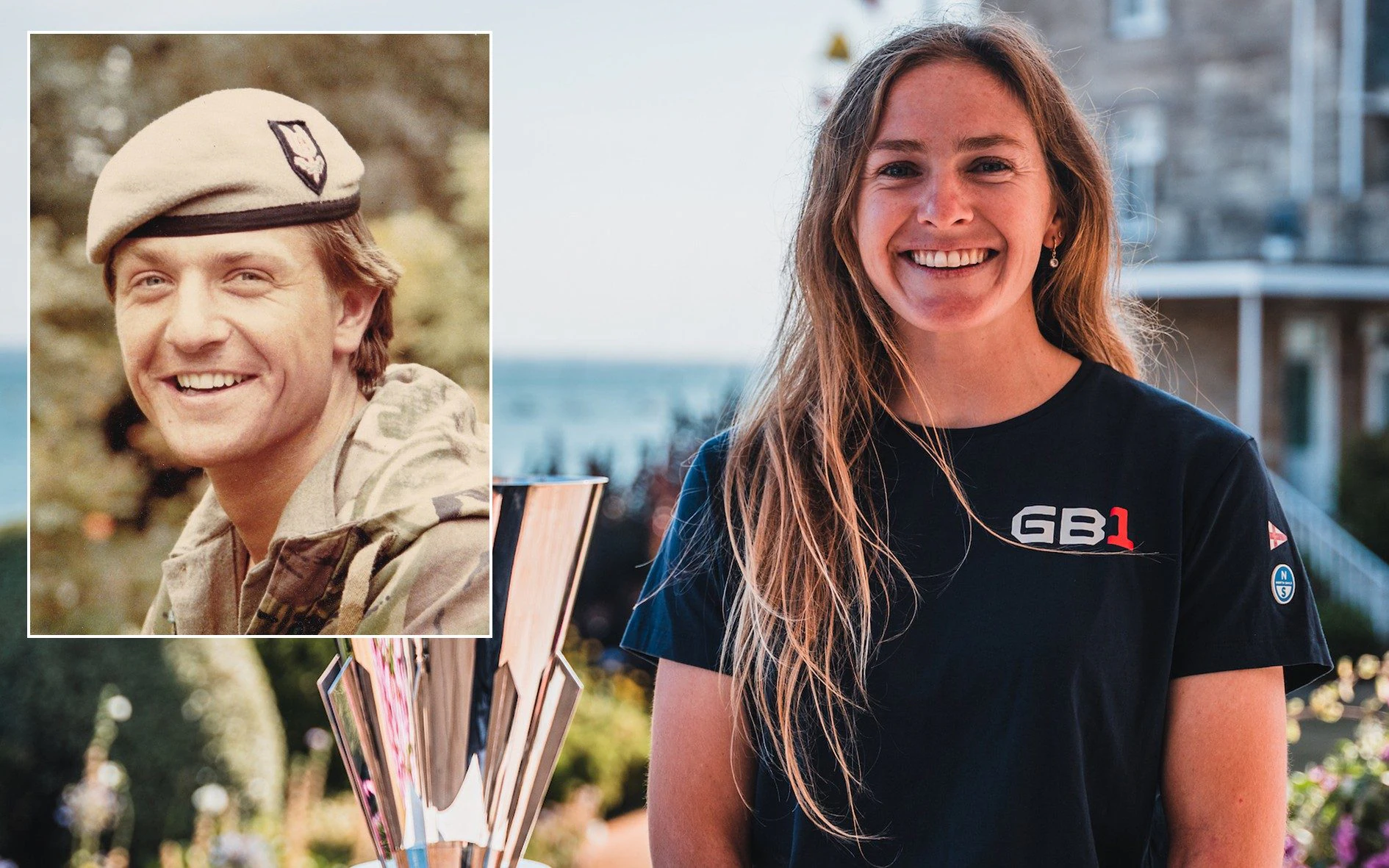
Jemima Lines, who has enjoyed extreme sports from an early age, will race with GB’s next challenger
Women have not always been welcomed with open arms at the Royal Yacht Squadron (RYS). The Cowes-based yacht club dates back to 1815, the year of the Battle of Waterloo, but only voted to allow female members in 2013.
The men-only policy has led to some awkward moments down the years. When Queen Victoria, who had a holiday home in nearby Osborne House, expressed a desire to watch the squadron’s annual regatta from the Castle, where the clubhouse is based, the members did not know what to do.
“Obviously they needed to accommodate the monarch,” says Bertie Bicket, the RYS’s commodore, with a smile. “But they also needed to stick to their rules. So they built a structure on the seaward side of the castle, now known as ‘The Platform’, with a kind of glass structure, along with some steps leading up to this new structure, so that it was possible to keep both the members and the monarch happy.”
It is fair to say times have changed. This year marks the 175th anniversary of the America’s Cup, which was also founded here in Cowes. So it felt rather symbolic that on Tuesday, GB1, Britain’s challenger for yachting’s best-known trophy, chose the club as the venue from which to announce Jemima Lines, a 29-year-old kitefoiler and adventurer, as their first female sailor since Phyllis Sopwith, wife of Sir Thomas Sopwith, in 1934 and 1937.
New rules – pushed for by the RYS and GB1, who will be sailing under the squadron’s flag in Naples next year – require all challengers to have at least one woman on board. Lines, who came through a rigorous application process, says she is thrilled to have been chosen.
“It’s totally surreal,” she says. “They kind of headhunted me. I think they had an idea of the role they wanted to fill and I sort of ticked most of the boxes.”
It is not hard to see why. Lines has the sort of CV that makes you wonder what you have been doing with your life. The fourth daughter of an former special forces soldier, she and her sisters, Lucy, Sasha and Polly, grew up in Kent and were encouraged from a young age to try everything and anything outdoorsy.
Receiving the call from Ian Walker, the chief executive, to tell her she had been selected for the America’s Cup, Lines says, was one of the proudest moments of her life. It was one of which her father “would have been so proud”. Sadly, Ralph Crathorne died earlier this year, aged 67, in a mountaineering accident in Scotland.
“My father was such a legend,” Lines reflects. “Everything I’ve ever done, how we’ve grown up, is because of him. We’d often be late to school because he had taken us all to the beach, and we’d be kiting before school, and we’d be running in late with wet hair, with all these excuses to our teachers. It was such a cool upbringing.
“We were climbing mountains in the Brecon Beacons practically from the moment we could crawl. And as we grew up, those adventures kind of scaled up with us.”
Lines is not exaggerating. Spurred on by the memory of her sister, Sasha, who died from a brain tumour aged eight, she has accomplished a frightening amount in her three decades. Lines was kitefoiling by eight, wearing “outsized adult harnesses with rash vests stuffed down the front to make it fit”, and later competed for the Great Britain team. By the time she had left school, where naturally she achieved her Duke of Edinburgh Gold Award, she was ready to take on bigger adventures.
In her gap year, she became an instructor for the Bear Grylls Survival Academy – nominated for the role by the man himself, who she knew through her father’s SAS background. “I still do it now,” she says. “I come in as a kind of consultant for events, really. Working alongside his safety team, helping with stunts and rigging, jumping out of helicopters. It’s a great gig and I mean, what a guy. I’m so lucky to have had role models like that. He has such an incredible can-do attitude.”
Lines also found time in her gap year to cycle solo and unsupported around the coast of Iceland (930 miles) and the full length of Norway (2,100 miles), using a bike dynamo for her power needs. She went on to read engineering at Bristol University where her dissertation on “The development of a kitefoiling velocity prediction program” was given a First Class award.
More recently, she has gained her Mountain Leaders’ qualification and has led expeditions to Everest base camp, Nepal (17,598 feet), Mt Toubkal, Morocco (13,671 feet) and K2 base camp, Pakistan (16,900 feet).
Have any thoughts?
Share your reaction or leave a quick response — we’d love to hear what you think!
-
 0
0
-
 0
0
-
 0
0
-
 0
0
-
 0
0
-
 0
0