Democrats Map Strategy for Potential Midterm Congressional Control

A Democratic victory in either the House or the Senate would grant the party significant leverage to check President Donald Trump’s administration, providing new avenues for oversight, government spending influence, and potential policy pushback. While party leaders acknowledge limits to what they can achieve against a Republican executive, the prospect of a legislative majority has prompted internal planning for both investigative efforts and specific policy initiatives. They will have powerful new tools to conduct oversight and investigate Trump’s government; a seat at the table when it comes to government spending; and potentially a mandate to undo some of the changes he has imposed or push for AI regulation he has opposed. And it may end up being inflation and affordability that turn voters against Trump, it was the affordability crisis and inflation that turned voters against President Joe Biden. With the majority comes the power to call hearings and subpoena witnesses.
President Trump has dismissed the threat of a divided government, stating recently that his response to a Democratic-majority Congress would be to veto incoming legislation and wait for the party to negotiate. Achieving any significant policy goals would likely require Democrats to attach their priorities to must-pass annual appropriations bills, an uphill battle that would require bipartisan cooperation to overcome a presidential veto. Especially since Trump, barred by the Constitution from seeking a third term, might not be willing to work with Democrats to keep the government functioning, and maintaining unity and resolve would take work. At least in the Senate, since the Democrats are not expected to gain enough seats in that chamber to approve bills without GOP votes, and that would take negotiating with Republicans. There’s little chance they could gain the kind of majority that would allow them to overturn his veto. But again, those things would require unlikely buy-in from Trump. Which means their leverage to force Trump to do things would be through the threat of taking away money, democrats’ main power point would be over the spending of taxpayer dollars. Although he has already overseen multiple protracted and unpopular lapses in funding during his presidencies, trump will need legislation from Congress in order to keep the government running. This is probably why Trump’s administration is trying to move quickly on things like the triumphal arch and the championship-level golf course he wants to use taxpayer money to build. Plus, it would take 67 votes — which would mean help from Republicans — to override Trump’s veto.
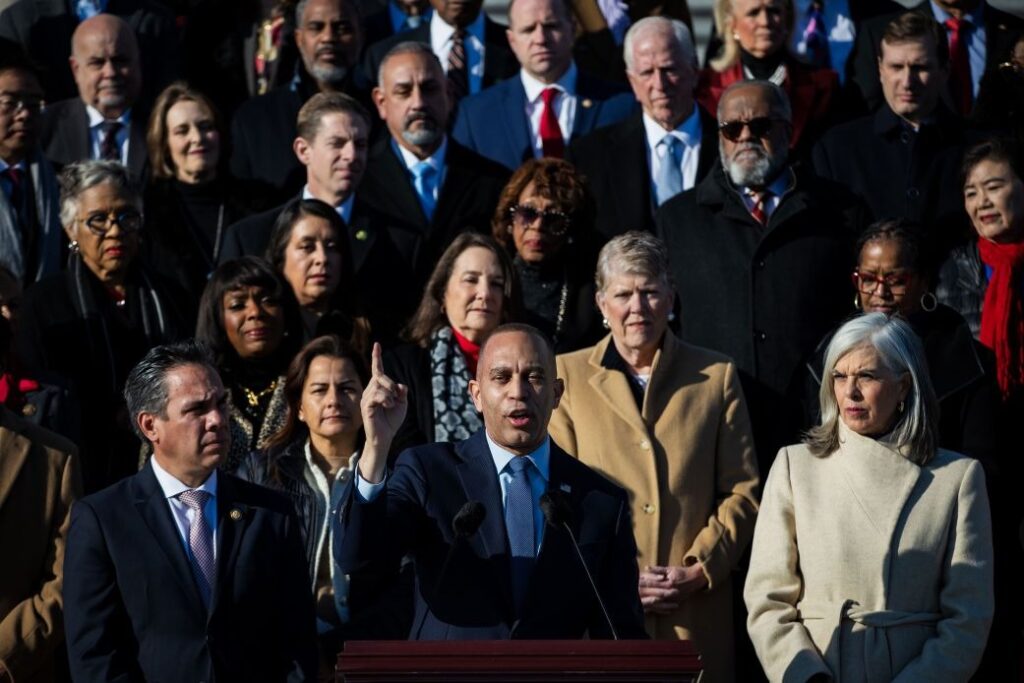
House Democratic leader Hakeem Jeffries has established working groups focused on five key areas: housing, healthcare, caregiving, energy, and the affordability of goods. The party’s stated priorities include reversing Medicaid cuts introduced in the Republican-led tax and spending package, renewing enhanced Affordable Care Act premium subsidies, and repealing recent tariffs. However, reversing the provisions of the administration’s “One Big Beautiful Bill Act” remains a major fiscal hurdle, as the Congressional Budget Office estimates a permanent extension of insurance subsidies alone would cost roughly $350 billion over a decade. These subsidies lapsed at the end of 2025, contributing to a 58% increase in premium costs this year and a significant decline in coverage enrollment. ► Ending the war to bring down energy prices. Which lapsed at the end of 2025, they shut down the government for a record 43 days last fall in an effort to pressure GOP leaders to extend the more generous assistance. And several million people have dropped their coverage, the enhanced subsidies’ expiration sent premium payments soaring 58% this year. Beautiful bill” will cost a lot of money, a daunting hurdle even for many in the caucus at a time when the national debt has topped $40 trillion, but Democrats also would have to deal with the reality that reversing or modifying some of the sweeping cuts in the “big. Such as those related to self-attestation, medical frailty and provider taxes, democrats might seek to delay or soften some of the provisions in the law and regulations. Trump has made more than $1 billion on crypto at a time when he could be overseeing its regulation. Hospitals, and states, among others, they are expected to actively monitor the rollout of the provisions and publicize their impact on enrollees and other Americans. Don’t expect the caucus to move forward on an expansion of Medicare to more Americans in the coming Congress, while several progressive Democratic candidates have pushed for Medicare for All on the campaign trail.
Democrats are also closely monitoring the impact of the Republican tax bill, which included the first-ever federal work requirements for certain aid programs. These mandates, effective January 1 in most states, have been linked to over 5.5 million people losing benefits since the law was signed in July 2025, according to the Food Research & Action Center. Additionally, the party intends to push the administration for transparency regarding “Most Favored Nation” drug pricing agreements and contrast their own student loan policies against Republican moves to reduce federal borrowing limits for students and parents.
Legislative oversight will serve as an immediate tool for a Democratic-led chamber. Lawmakers plan to scrutinize the Department of Government Efficiency, headed by Elon Musk, and investigate the administration’s efforts to restructure or dismantle agencies such as USAID, the Department of Education, and the Consumer Financial Protection Bureau. Oversight efforts will also extend to the President’s personal business dealings, including his cryptocurrency ventures, as well as the actions of his family members during his term. Many questions remain about the so-called Department of Government Efficiency he launched with Trump’s blessing.
The administration’s most contentious policies—ranging from the war in Iran and mass deportation programs to large-scale capital infrastructure projects—will face intense congressional scrutiny. Democrats also plan to review the conduct of cabinet members, including Defense Secretary Pete Hegseth, Commerce Secretary Howard Lutnick, Interior Secretary Doug Burgum, Homeland Security Secretary Markwayne Mullin, and the Attorney General.
Fiscal battles are also expected to return to the forefront. Congress will likely face another debt ceiling debate in 2027, following a $5 trillion increase authorized under the previous tax legislation. Despite these plans, Democrats are not expected to advance major measures to address the long-term insolvency of Social Security and Medicare, which are projected to face depletion in the early 2030s.